
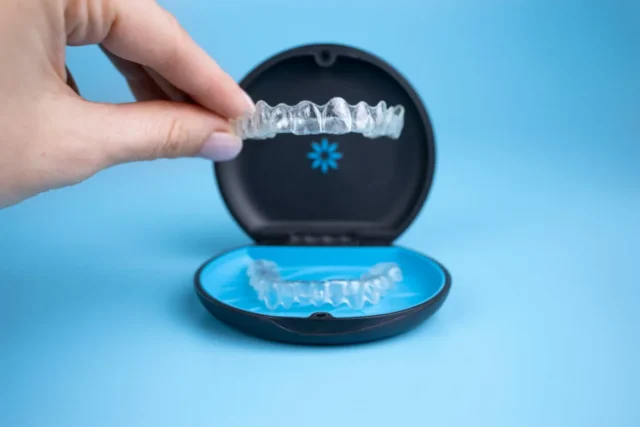
How Invisalign Works
Invisalign is a clear aligner orthodontic system that gradually moves teeth into a planned final position using a series of custom-made plastic trays. Each tray is worn for 1–2 weeks before being replaced with the next tray in the sequence. Total treatment usually requires 20–50 trays over 6–18 months.
The Invisalign process:
- Initial consultation. We take digital scans of your teeth (no goopy impressions), photos, and X-rays. The data is sent to Invisalign’s planning system.
- Treatment plan preview. Within 1–2 weeks, you receive a 3D digital preview showing exactly how your teeth will move from start to finish — including a preview of your final smile.
- Aligner manufacturing. Once you approve the plan, the full set of custom trays is fabricated and shipped to our office.
- Active treatment. You wear each tray 22 hours per day, removing them only to eat, drink (anything but water), and brush. You change to a new tray every 1–2 weeks.
- Check-ups. We see you in the office every 6–8 weeks to confirm progress and provide the next set of trays.
- After active treatment, you wear retainers (either clear retainer trays or fixed wires behind the teeth) indefinitely to maintain results.
Cost Breakdown — Mild, Moderate, Complex Cases
Invisalign pricing is driven primarily by case complexity, measured by:
- How much the teeth need to move
- Whether attachments (small bumps on the teeth) are needed
- Whether interproximal reduction (gentle filing between teeth to create space) is required
- Total number of aligners needed
- Whether you need a refinement phase at the end
Mild cases ($3,500–$5,000):
- Minor crowding (less than 3 mm of overlap)
- Small gaps that can be closed
- Minor cosmetic adjustment of front teeth
- Express treatment options (Invisalign Lite, 5–7 aligners) often start at $3,500
- Treatment typically 4–8 months
Moderate cases ($5,000–$6,500):
- Moderate crowding (3–6 mm)
- Crossbite or mild bite correction
- Need for attachments and IPR
- 15–30 aligners
- Treatment typically 8–14 months
Complex cases ($6,500–$8,000+):
- Severe crowding or spacing
- Significant bite correction (overbite, underbite, open bite)
- Treatment of both upper and lower arches with complex movement
- 30–50+ aligners, often with refinement phases
- Treatment typically 14–24 months
At Dentist of Aventura, the consultation and treatment plan preview are free. You see the exact cost and timeline before committing to treatment.
Realistic Timeline — What Results Look Like Over Time
Patients often ask: “When will I start seeing results?”
Month 1: You’re getting used to wearing aligners. The first 24–48 hours of each new tray feel tight; this fades quickly. Most people notice no significant visual change yet, but the teeth are starting to move.
Month 2–3: Front teeth show the first visible changes. Small gaps close, mild rotations correct. This is when most patients start to feel encouraged.
Month 4–6: Significant visible progress. About 40–60% of total movement is complete by month 6 for typical cases. Many short-treatment patients are nearly finished.
Month 6–12: Final positioning of teeth and bite. Subtle but important movements that finish the work.
Month 12–18: Refinement, if needed. About 30% of patients need a refinement phase — a small additional set of aligners to perfect the final result. This is normal and is usually included in the original treatment cost.
After treatment: Retainers indefinitely. Skipping retainers is the #1 reason orthodontic results don’t last. We provide clear Vivera retainers at the end of treatment.
Invisalign vs Other Clear Aligner Brands
Invisalign vs Other Clear Aligner Options
| Brand | Cost Range | Treatment Length | Best For |
| Invisalign | $3,500–$8,000 | 6–18 months | All cases, gold standard |
| ClearCorrect | $2,500–$5,500 | 6–18 months | Similar to Invisalign, slightly cheaper |
| Spark Aligners | $3,000–$6,000 | 6–18 months | Premium alternative, very clear |
| SureSmile | $3,500–$7,000 | 6–18 months | In-office system, customizable |
| Mail-order (SmileDirect, etc.) | $1,800–$2,500 | 4–6 months | Mild cases only, no dentist supervision |
Invisalign is the best-known and best-supported clear aligner system, used in over 15 million cases worldwide. The technology, prediction algorithms, and material quality are well-established.
Mail-order aligner companies (SmileDirectClub closed in 2024, but others still operate) are tempting because of low price, but they treat patients without in-person dental examination. The American Dental Association and most orthodontists strongly recommend against mail-order aligners due to documented complications — including unwanted tooth movement, bite problems, and gum recession. Treatment should be supervised by a licensed dentist.
At Dentist of Aventura, we primarily use Invisalign and offer alternative systems for patients with specific needs.
Invisalign vs Traditional Braces
Many adult patients ask whether to choose Invisalign or traditional metal braces. The honest answer depends on your case.
Invisalign advantages:
- Nearly invisible — important for adults in client-facing professions
- Removable — you can eat normally, brush and floss easily
- Fewer office visits — every 6–8 weeks vs every 4 weeks for braces
- Generally more comfortable — no metal poking the cheek
Invisalign limitations:
- Requires patient compliance — you must wear 22 hours per day. Patients who don’t wear consistently won’t get results.
- Some complex cases (severe rotation, jaw discrepancies) are still better treated with braces or with hybrid approaches.
- Lower-arch posterior teeth (back lower molars) are harder to move with aligners than with braces.
Traditional braces advantages:
- Predictable — no patient compliance required
- Can move teeth in more complex ways
- Sometimes faster for severe cases
- Lower cost for some cases ($3,000–$6,000)
For most adult patients with moderate orthodontic needs, Invisalign is the preferred option today. For severely crowded teeth or complex bite problems, especially in teenagers, braces may still be the better tool.
Insurance and HSA/FSA in Florida
Orthodontic insurance coverage in Florida varies significantly by plan:
Adult orthodontic coverage. Most plans either don’t cover adult orthodontics at all, or cover it once-per-lifetime up to a maximum (typically $1,000–$3,000). Check your specific plan.
Child orthodontic coverage. Most family plans include coverage for children, typically $1,500–$2,500 lifetime maximum, age-limited (often under 19).
Invisalign vs braces coverage. Insurance usually treats Invisalign and braces the same way under orthodontic benefits. There is rarely a difference in coverage.
HSA and FSA. Both Health Savings Accounts and Flexible Spending Accounts can be used to pay for orthodontic treatment, including Invisalign. This is one of the most tax-efficient ways to pay — you save your marginal tax rate (often 30–40%) on the treatment cost.
CareCredit and payment plans. For costs not covered by insurance, we offer CareCredit financing with 0% APR plans for qualifying patients, plus in-house monthly payment plans. Many patients pay for Invisalign at $300–$500 per month over 12–18 months.
We verify your specific orthodontic coverage during the free consultation and provide a written cost breakdown including insurance, HSA/FSA, and any out-of-pocket portion.
Common Reasons Adults in Aventura Choose Invisalign
Looking at our Invisalign patient base, the top reasons patients in Aventura, Sunny Isles, Bal Harbour, and surrounding areas come in:
- Crowded front teeth that have shifted over time (most common — 40% of cases)
- Gaps between teeth they want to close
- Mild bite issues causing tooth wear or jaw discomfort
- Preparation for cosmetic dentistry (veneers placed over straight teeth look much better than over crooked teeth)
- Relapse from previous orthodontic treatment (people who had braces as teens and stopped wearing retainers)
- Adult patients who never had braces and are finally treating their smile
- Wedding or major event preparation
If you’ve been thinking about straightening your smile but weren’t sure whether Invisalign would work for you, a free consultation will give you a clear answer. Most adults are candidates.
Frequently Asked Questions
Q1. Does Invisalign hurt?
There’s discomfort when you switch to each new tray — usually for the first 24–48 hours. It’s more pressure than pain. Most patients describe it as the feeling of teeth being slightly squeezed. The discomfort fades quickly and is much less than traditional braces.
Q2. How many hours per day do I have to wear Invisalign?
22 hours per day minimum. You can remove the aligners to eat, drink anything besides water, and to brush and floss. Patients who don’t wear consistently 22 hours don’t get results — this is the single biggest factor in treatment success.
Q3. Can I drink coffee with Invisalign in?
Water only with the aligners in. Coffee will stain both the aligners and your teeth (because the liquid gets trapped against the enamel). Remove the aligners, drink your coffee, rinse your mouth, and put the aligners back in.
Q4. Will Invisalign work for severely crooked teeth?
Modern Invisalign can handle most cases that previously required braces, including significant crowding, rotations, and bite correction. Very severe cases — particularly jaw discrepancies in growing teenagers — may still be better treated with braces. The free consultation includes a digital preview that shows exactly what’s possible.
Q5. How much is Invisalign for adults in Aventura?
Adult Invisalign at our office in Aventura typically ranges from $3,500 for mild cases to $8,000 for complex cases. The free consultation includes an exact quote for your specific situation. Insurance, HSA, FSA, and CareCredit financing can significantly reduce out-of-pocket cost.
Q6. Do I need to wear a retainer forever after Invisalign?
Yes — but full-time wear is only for a few months. After that, most patients wear retainers only at night, indefinitely. Skipping retainers is the #1 reason orthodontic results don’t last. We provide clear Vivera retainers at the end of treatment.
Q7. Can I get Invisalign if I have crowns or veneers?
Yes in most cases. Crowns and veneers don’t move teeth differently than natural teeth, though attachments may not bond as well to porcelain — so we plan around those teeth. We discuss your specific situation during the consultation.
About the author
Dr. Elaine Perez-Gutierrez, DMD is a general and surgical dentist at Dentist of Aventura, licensed in both the United States and Cuba. She holds a Doctor of Dental Medicine (DMD) degree and brings a wealth of international training in evidence-based dentistry to her practice. Her clinical focus includes advanced oral surgery and implantology — same-day extractions and implant placement, full-arch All-On-X restorations, bone augmentation, sinus lift procedures, and complex restorative cases. She also performs cosmetic and restorative work including porcelain veneers, zirconia crowns, bridges, and root canal therapy. Read her full bio here.
📞 To schedule your free implant consultation: (786) 686-0162
📍 2627 NE 203rd St #112, Aventura, FL 33180
🗓 Book online | More FAQs | Contact us