
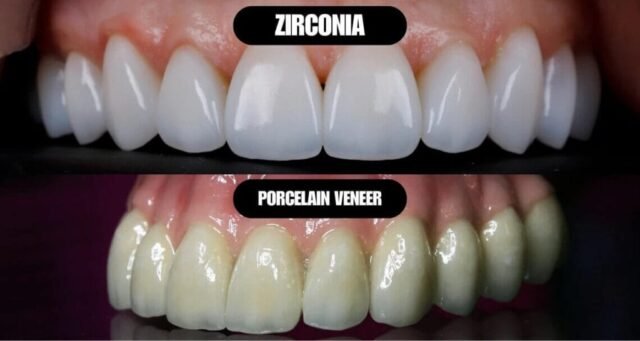
What Is a Dental Crown?
A dental crown is a custom-made cap that covers an entire tooth above the gum line. Crowns are used when a tooth is too damaged to be restored with a filling — for example, after a large cavity, a fracture, a root canal, or significant wear. The crown restores the tooth’s shape, function, and appearance, and protects it from further damage.
There are several types of crown materials. The two most common in modern dentistry are zirconia and porcelain (specifically porcelain-fused-to-metal, PFM, or all-ceramic porcelain). Both are tooth-colored, strong, and aesthetic — but they differ in important ways that affect which is right for your specific situation.
Strength and Durability — Laboratory Data
Strength is measured in megapascals (MPa) of flexural strength — the force required to break the material. Higher number = stronger material.
- Full-contour zirconia: 900–1,400 MPa (strongest dental ceramic available)
- Layered zirconia: 600–900 MPa
- max lithium disilicate (modern “porcelain”): 360–400 MPa
- Traditional feldspathic porcelain: 60–90 MPa
- Porcelain-fused-to-metal (PFM): 400–500 MPa (the metal substructure provides the strength)
- Natural enamel: 380 MPa (for reference)
Practical implications:
- Zirconia is approximately 3x stronger than e.max porcelain. It is virtually impossible to break under normal chewing forces.
- For patients who grind their teeth at night (bruxism), zirconia is significantly safer.
- For molars (back teeth), where biting forces can exceed 200 lbs, zirconia is the more conservative choice.
- For front teeth, where chewing forces are lower and aesthetics matter more, porcelain is acceptable and often preferable.
Aesthetics — Front Teeth vs Back Teeth
Here is where porcelain has historically had an advantage. Natural enamel is slightly translucent — light passes through it and reflects off the underlying tooth structure, creating subtle depth and color variation. High-end porcelain (e.max layered, feldspathic) mimics this translucency very well.
Older zirconia was opaque white and looked “too perfect,” especially when placed next to natural teeth. It worked fine for molars (where translucency doesn’t matter) but stood out on front teeth.
Modern advances have changed this. Today’s monolithic zirconia (“aesthetic zirconia”) is available in pre-shaded blocks with translucency that approaches porcelain. For most patients and most observers, modern aesthetic zirconia on a front tooth looks essentially identical to porcelain.
That said, for the most demanding cosmetic cases — celebrities, models, anyone with a critical eye for the smile zone — layered porcelain still has a small but real edge in aesthetic nuance.
Our general approach at Dentist of Aventura:
- Back molars: zirconia for strength
- Premolars and front teeth: porcelain or aesthetic zirconia, based on the patient’s preferences and other factors
- Patients with bruxism (grinding): zirconia, with a custom night guard
Cost Comparison in Aventura
Zirconia vs Porcelain Crown — Cost and Features
| Factor | Zirconia Crown | Porcelain Crown (e.max) |
| Cost per crown | $1,000–$1,800 | $800–$1,500 |
| Strength (MPa) | 900–1,400 | 360–400 |
| Aesthetic translucency | Good (modern aesthetic) | Excellent |
| Lifespan | 15–25 years | 10–15 years |
| Best for | Molars, grinders, longevity | Front teeth, premium aesthetics |
| Same-day option | Yes (with CEREC) | Yes (with CEREC) |
| Bonding/cementation | Cement or bond | Bond (acid-etch) |
| Wear on opposing teeth | Polishes smoothly | Slightly more abrasive |
How Long Does Each Last?
Lifespan depends on placement, oral hygiene, and the patient’s bite — but published research and our own clinical experience give clear averages.
Zirconia crowns:
- 5-year survival: 96–98%
- 10-year survival: 92–95%
- 15-year survival: 88–92%
- Beyond 20 years: well-maintained zirconia crowns can last 25+ years
The most common reasons a zirconia crown fails are decay in the underlying tooth (not failure of the crown itself), gum recession that exposes the margin, or root issues unrelated to the crown.
Porcelain crowns:
- 5-year survival: 95–97%
- 10-year survival: 88–93%
- 15-year survival: 75–85%
Porcelain crowns fail by chipping or fracturing more often than zirconia. The all-ceramic core can crack, especially under heavy biting forces or in grinders. A chipped porcelain crown usually has to be replaced — repair is possible but rarely satisfactory long-term.
For a patient choosing between the two purely on longevity, zirconia wins.
Same-Day vs Lab-Made Crowns
Modern dentistry offers two paths to a crown:
Lab-made crowns. The traditional approach. Your tooth is prepared, an impression is taken (digital or physical), and the impression is sent to a dental laboratory where a technician fabricates the crown over 2–3 weeks. You wear a temporary crown in the meantime. The final crown is bonded at a second visit.
This approach allows the highest aesthetic refinement — a master ceramist can layer porcelain by hand to match adjacent teeth precisely. For front-tooth cases especially, lab-made is often preferred.
Same-day (CEREC) crowns. The tooth is scanned with a 3D digital scanner; the crown is designed on a computer; a milling machine carves it out of a single block of ceramic right in the office. The whole process takes 60–90 minutes. The crown is bonded the same day.
Same-day crowns are ideal for back teeth, broken teeth that need urgent restoration, and patients who don’t want to wear a temporary. The aesthetic quality is excellent, though slightly less customizable than hand-layered lab work.
At Dentist of Aventura, both options are available. We discuss which fits your case during the consultation.
Made-in-USA Standard at Dentist of Aventura
For patients who care about where their dental restorations are manufactured, here is what we use:
All zirconia and porcelain crowns at our office are fabricated by US-based dental laboratories using FDA-approved materials. We do not outsource to overseas labs for any cosmetic restoration.
This matters for a few reasons:
- Quality control. US labs operate under FDA regulations with documented material sourcing.
- When a case needs refinement — a slight shade adjustment, a contour change — we can talk to the technician directly and turn it around quickly.
- Material traceability. We can document exactly what was used in each crown, which matters if you ever need information about your dental work in the future.
Implants placed at our office use the Implant Direct system, also manufactured in the USA, for the same reasons.
When to Choose Zirconia — When to Choose Porcelain
Quick decision framework:
Choose zirconia if:
- The crown is going on a back tooth (molar or premolar)
- You grind your teeth at night
- You’ve had crowns chip or break in the past
- You want the longest-lasting option
- You’re treating multiple teeth and want consistency
- Cost is a moderate concern (zirconia is slightly more but lasts longer per dollar)
Choose porcelain if:
- The crown is going on a front tooth and aesthetics are critical
- You don’t grind your teeth
- You want maximum natural translucency
- You’re matching to existing natural teeth that have natural light reflection
- You’re comfortable with replacing the crown in 10–15 years
For most patients, the best plan is mixed: zirconia for molars, porcelain (or aesthetic zirconia) for front teeth.
Frequently Asked Questions
Q1. Will a zirconia crown match my other teeth?
Modern zirconia is available in pre-shaded blocks across the full range of natural tooth colors. A skilled technician can match the color of your other teeth closely. For very demanding cosmetic cases, hand-layered porcelain still has a slight edge in aesthetic depth, but for most patients zirconia is indistinguishable from natural teeth.
Q2. Can I get a same-day crown in Aventura?
Yes. We offer same-day crown options using digital scanning and in-office milling. The whole process — from preparation to permanently cemented crown — takes about 90 minutes to 2 hours. Same-day crowns are typically available for both zirconia and certain porcelain materials.
Q3. Does insurance cover zirconia vs porcelain crowns?
Most PPO insurance plans cover crowns under ‘major services’ at approximately 50%, subject to annual maximums ($1,500–$2,500). Coverage usually applies equally to zirconia and porcelain — the choice between materials is yours. We verify exact coverage before treatment.
Q4. Is a zirconia crown too hard? Will it damage my other teeth?
Modern monolithic zirconia is polished to a glass-smooth surface that is actually gentler on opposing teeth than rough porcelain. Early zirconia (10+ years ago) caused wear on opposing teeth, but current materials and polishing techniques have eliminated that issue.
Q5. Can a zirconia crown crack or break?
It’s extremely rare. Zirconia has roughly 3x the flexural strength of natural enamel. The most common ‘failure’ isn’t the crown itself breaking — it’s decay developing in the underlying tooth structure or gum recession exposing the margin. Routine cleanings prevent both.
Q6. How long after the crown is placed can I eat normally?
Right away in most cases. Both zirconia and modern porcelain crowns are fully bonded at placement, and you can eat normally as soon as the anesthesia wears off (1–2 hours). We do recommend avoiding very hard or sticky foods for the first 24 hours just to let everything settle.
Q7. Why does crown cost vary so much between dentists?
Three main reasons: the lab used (US-based labs cost more than offshore), the material (premium zirconia and layered porcelain cost more), and the dentist’s experience and overhead. Very cheap crowns ($600 or less) often reflect overseas-lab work that may not match your other teeth well. Very expensive crowns ($2,000+) usually reflect hand-layered porcelain by master ceramists for high-cosmetic-demand cases.
About the author
Dr. Elaine Perez-Gutierrez, DMD is a general and surgical dentist at Dentist of Aventura, licensed in both the United States and Cuba. She holds a Doctor of Dental Medicine (DMD) degree and brings a wealth of international training in evidence-based dentistry to her practice. Her clinical focus includes advanced oral surgery and implantology — same-day extractions and implant placement, full-arch All-On-X restorations, bone augmentation, sinus lift procedures, and complex restorative cases. She also performs cosmetic and restorative work including porcelain veneers, zirconia crowns, bridges, and root canal therapy. Read her full bio here.
📞 To schedule your free implant consultation: (786) 686-0162
📍 2627 NE 203rd St #112, Aventura, FL 33180
🗓 Book online | More FAQs | Contact us