
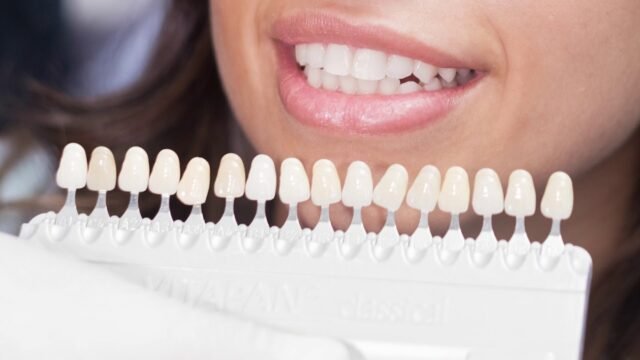
Average Cost per Veneer in Aventura, FL
In Aventura and the broader South Florida market, porcelain veneers cost between $1,000 and $2,500 per tooth. The wide range reflects real differences in the product and service.
Lower end ($1,000–$1,400 per veneer):
- Standard pressed porcelain (e.max press is common at this tier)
- Lab work often done in larger commercial labs, sometimes offshore
- General cosmetic work, less personalized smile design
- Common for single-tooth replacements rather than full smile makeovers
Mid-range ($1,500–$1,900 per veneer):
- Premium pressed porcelain (e.max layered) or feldspathic porcelain
- US-based dental laboratories
- Includes digital smile design, photography, and a wax-up preview
- Most full smile makeovers fall in this tier
Premium ($2,000–$2,500+ per veneer):
- Hand-crafted feldspathic porcelain by master ceramists
- Dedicated cosmetic dentists with portfolios of similar work
- Includes full digital smile design with try-in mockups
- 3D-printed temporaries to preview the final look
- Common for celebrity-style smile transformations
At Dentist of Aventura, our veneers are crafted by US-based laboratories using e.max and similar high-quality porcelain materials. Pricing varies based on the case but most fall in the mid-range.
Full Smile Makeover (6, 8, 10 Veneers) — Cost Examples
Most smile makeovers involve the 6 to 10 most visible front teeth. The exact number depends on how wide your smile is — how many teeth show when you smile broadly — and what cosmetic issues you’re addressing.
Typical bundle pricing at our office:
- 4 veneers (top 4 front teeth) — $5,000–$9,500
- 6 veneers (top 6 front teeth, most common) — $7,500–$15,000
- 8 veneers (top 8 front teeth, wider smiles) — $10,000–$20,000
- 10 veneers (full smile zone) — $12,000–$25,000
- 20 veneers (full upper and lower smile zone, “Hollywood smile”) — $24,000–$50,000
These ranges include the consultation, digital smile design, photographs, custom temporaries, and final placement. Some patients additionally need orthodontic preparation (Invisalign), whitening of non-veneered teeth, or gum contouring to achieve a balanced result — these are quoted separately.
What Affects the Price of Porcelain Veneers?
Six factors drive the price difference between practices:
- The dental laboratory. The lab that fabricates the veneers is often the biggest cost variable. Master ceramists in US labs charge $400–$700 per veneer just for lab fees; offshore labs charge $80–$150. The aesthetic difference is real, especially for front-tooth cases where natural color variation and translucency matter.
- The type of porcelain. Pressed porcelain (e.max) is strong and beautiful — appropriate for most cases. Feldspathic porcelain layered by hand is more aesthetically nuanced but more fragile and more expensive. Zirconia veneers are stronger but less translucent.
- The dentist’s experience and case load. A general dentist who places 5 veneers per year charges differently than a dentist who places 200 per year. Experience affects predictability — fewer surprises, fewer remakes, better long-term results.
- Smile-design technology. Practices that include digital smile design, mock-up previews, and 3D-printed temporaries spend more time and resources per case. The result is better preview accuracy and fewer revisions.
- The complexity of your case. Some patients need teeth straightened first (Invisalign), gum contouring, or replacement of underlying restorations before veneers can be placed. These prep steps add cost but ensure long-term success.
- Geographic market. Aventura, Bal Harbour, and Sunny Isles are higher-cost-of-living areas, which is reflected in dental fees relative to other parts of South Florida. Pricing at our office is competitive within the local market.
Porcelain vs Composite Veneers — Cost vs Longevity
Porcelain vs Composite Veneers
| Factor | Porcelain Veneers | Composite Veneers |
| Cost per tooth | $1,000–$2,500 | $300–$700 |
| Lifespan | 10–20+ years | 4–8 years |
| Stain resistance | Excellent | Moderate |
| Strength | Very strong | Moderate |
| Procedure visits | 2–3 visits | 1 visit (often same-day) |
| Best for | Long-term smile transformation | Single tooth fixes, budget option |
| Aesthetic result | Highly natural, light-reflective | Good, but less depth |
Composite (bonded) veneers are a less expensive alternative that can be applied in a single visit, with the resin material sculpted directly onto the tooth. They look good initially but stain and chip over time, and last only 4–8 years on average. Composite is appropriate for patients on a tight budget or for fixing one or two teeth.
Porcelain costs more upfront but lasts 2–3x longer and looks more natural in the long term. For most patients investing in a smile transformation, porcelain is the better value.
Does Insurance Cover Porcelain Veneers?
Almost never. Dental insurance classifies veneers as cosmetic — meaning treatment chosen for aesthetic improvement rather than medical necessity — and excludes them from coverage.
The rare exceptions:
- If a tooth is significantly damaged from decay or trauma and a veneer is the restorative solution, partial coverage is sometimes available. This is unusual.
- If a veneer is needed to repair a fractured tooth structure rather than improve appearance, the procedure may be billed as a different code that has partial coverage.
In practice, you should expect to pay the full cost out of pocket for veneers.
If your situation is borderline — for example, a chipped front tooth from a sports injury — call us and we can review your insurance benefits before treatment. We are honest about what insurance will and won’t cover. We don’t promise coverage we can’t deliver.
Payment Plans at Dentist of Aventura
Since insurance rarely covers veneers, financing matters. We offer:
CareCredit. The most widely-used medical financing in the US. Qualified patients can get 0% APR for 6, 12, 18, or 24 months on amounts from $500 to $25,000+. Application is online and takes 5 minutes; most decisions are immediate.
In-house payment plans. For patients who qualify, we offer structured monthly payment plans split over 3–12 months without credit-check applications.
LendingClub Patient Solutions and Sunbit. Alternative medical financing providers with different qualification criteria. Worth applying through multiple if CareCredit doesn’t approve at the desired terms.
Phased treatment. For larger smile makeovers, we can sometimes complete the work over two calendar years — taking advantage of insurance benefits (where applicable) and spreading costs across two tax years.
Our full /finance/ page lists current options and links to applications.
What to Expect During the Veneer Procedure
Visit 1 — Consultation and smile design (60–90 minutes). You meet with Dr. Ruben Journo, DDS, who handles most of our cosmetic cases. We take photos, digital scans, and X-rays. We discuss your goals — color, shape, length, overall look — and use smile-design software to preview the result. You leave with a written estimate and a recommended treatment plan.
Visit 2 — Preparation (90–120 minutes). The front surface of each tooth being veneered is reduced by approximately 0.5 mm (the thickness of a fingernail) to make room for the porcelain. Impressions are taken. Custom temporary veneers are placed so you have a preview of the final look while the permanent veneers are being fabricated.
Lab work — 2–3 weeks. The veneers are fabricated by our partner US lab.
Visit 3 — Final placement (90–120 minutes). The temporaries are removed. Each veneer is checked for fit, color, and aesthetics. When you approve the result, they are permanently bonded with light-cured cement.
You leave with a new smile. Some sensitivity for a few days after placement is normal.
Frequently Asked Questions
Q1. Do porcelain veneers ruin your natural teeth?
Modern veneers require only minimal tooth preparation — about 0.5 mm of enamel removal, less than the thickness of a fingernail. The natural tooth structure underneath is preserved. However, the preparation is permanent — once a tooth has been prepped for a veneer, it will always need a veneer or crown going forward.
Q2. How long do porcelain veneers last?
Premium porcelain veneers last 10–20 years with normal care. Many patients keep them for 15+ years with no issues. The most common reasons for replacement are chipping (from biting hard objects), staining of the adhesive line over time, or changes in the surrounding teeth or gums that affect aesthetics.
Q3. Can I get veneers if I have crooked teeth?
In some cases yes — veneers can mask mild crookedness and create the appearance of straight teeth. For significantly crooked teeth, we usually recommend Invisalign first to align the teeth, then veneers for final aesthetic refinement. Veneers placed over crooked teeth often look bulky and don’t hold up as well.
Q4. Will my insurance cover any portion of veneers?
Almost never. Dental insurance classifies veneers as cosmetic and excludes them. The exception is when a veneer is needed to restore a tooth damaged by trauma or decay — in those cases, partial coverage is sometimes available under restorative benefits.
Q5. Can veneers be whitened later if they stain?
No. Porcelain doesn’t respond to whitening. The good news is that porcelain doesn’t stain like natural teeth — it’s actually more resistant to staining than enamel. If your veneers eventually look discolored, it’s usually because your surrounding natural teeth have stained, making the veneers look comparatively yellow.
Q6. What’s the difference between veneers and crowns?
A veneer covers only the front (visible) surface of a tooth and is about 0.5 mm thick. A crown covers the entire tooth — front, back, and chewing surface — and is much thicker. Veneers preserve more of the natural tooth and are ideal for cosmetic improvements. Crowns are needed when the tooth itself is structurally damaged or weakened.
Q7. How do I take care of my veneers to make them last?
Brush twice daily, floss daily, and visit us every 6 months for cleanings and check-ups. Avoid biting hard objects (ice, fingernails, pens). If you grind your teeth at night, wear a custom night guard — grinding is the single biggest cause of premature veneer failure.
About the author
Dr. Elaine Perez-Gutierrez, DMD is a general and surgical dentist at Dentist of Aventura, licensed in both the United States and Cuba. She holds a Doctor of Dental Medicine (DMD) degree and brings a wealth of international training in evidence-based dentistry to her practice. Her clinical focus includes advanced oral surgery and implantology — same-day extractions and implant placement, full-arch All-On-X restorations, bone augmentation, sinus lift procedures, and complex restorative cases. She also performs cosmetic and restorative work including porcelain veneers, zirconia crowns, bridges, and root canal therapy. Read her full bio here.
📞 To schedule your free implant consultation: (786) 686-0162
📍 2627 NE 203rd St #112, Aventura, FL 33180
🗓 Book online | More FAQs | Contact us