
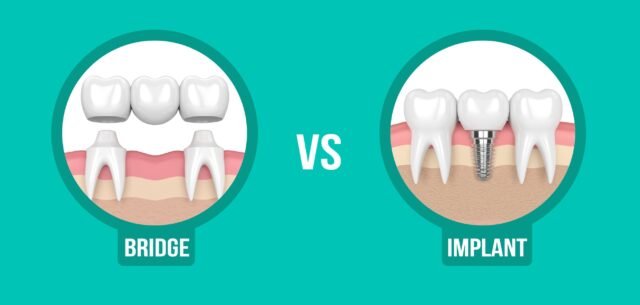
What Is a Dental Implant?
A dental implant is a small titanium screw that is surgically placed into the jawbone to replace the root of a missing tooth. Over 3–6 months, the implant fuses with the bone in a process called osseointegration. After integration, a custom-made crown is attached to the implant, creating a replacement tooth that looks, feels, and functions like a natural one.
The result is a stand-alone replacement tooth that doesn’t touch or rely on any neighboring teeth. It is the closest thing modern dentistry offers to a real tooth — both biologically and functionally.
At Dentist of Aventura, we use the Implant Direct system, manufactured in the USA, which has documented long-term success rates above 95% at 10 years.
What Is a Dental Bridge?
A dental bridge is a fixed prosthetic that replaces one or more missing teeth by anchoring to the teeth on either side of the gap. The two anchor teeth are filed down and capped with crowns; the missing tooth in the middle is a “pontic” — a fake tooth that bridges the gap.
A traditional three-unit bridge thus involves three crowns: two on the abutment (anchor) teeth, and one as the artificial tooth. The bridge is cemented permanently in place — it doesn’t come out like a denture.
Bridges have been used in dentistry for decades and remain a reliable option in certain situations. But they have a major downside that didn’t exist before modern implants: the two anchor teeth must be permanently altered.
How Each Option Works — Procedure Comparison
Here is what to expect with each treatment.
Dental implant timeline:
- Visit 1: Consultation, 3D CBCT scan, treatment plan (60–90 minutes)
- Visit 2: Implant surgery — local anesthesia, the implant is placed in the bone (45–60 minutes)
- Healing: 3–6 months of osseointegration; the patient typically has a temporary tooth during this time
- Visit 3: Abutment placement and impression for crown (30 minutes)
- Visit 4: Final crown placement (30 minutes)
Total active appointment time: about 3 hours spread across 4–6 months.
Dental bridge timeline:
- Visit 1: Consultation, X-rays, treatment plan (60 minutes)
- Visit 2: Preparation — both anchor teeth are filed down; impressions taken; temporary bridge placed (90 minutes)
- Lab: 2–3 weeks to fabricate the bridge
- Visit 3: Final bridge placement and cementation (60 minutes)
Total active appointment time: about 3.5 hours spread across 3–4 weeks.
The bridge is faster to complete. The implant takes longer but does more.
Cost Comparison in Aventura
Implant vs Bridge — Direct Cost Comparison (Aventura, FL 2026)
| Factor | Single Dental Implant | 3-Unit Bridge |
| Upfront cost | $3,500–$6,000 | $1,500–$3,500 |
| Includes | Implant + abutment + crown | Two anchor crowns + 1 pontic |
| Bone grafting (if needed) | +$500–$2,000 | Not applicable |
| Expected lifespan | 20+ years (often lifetime) | 5–15 years |
| Lifetime cost (40 years) | $4,000–$6,000 (one-time) | $4,500–$10,500 (2–4 replacements) |
| Insurance coverage | Often partial (30–50%) | Often partial (50%) |
The 40-year lifetime cost calculation matters. Because bridges typically need to be replaced every 10–15 years, a patient choosing a bridge at age 50 will likely need to replace it 2–3 times by age 90. The cumulative cost often exceeds what a single implant would have cost — and the bridge requires increasingly invasive work on the same anchor teeth each time.
That said, for older patients (75+) or in temporary situations, the lower upfront cost of a bridge can be a sensible practical choice.
Longevity — Why Implants Usually Win Long-Term
Implants last because they are made of titanium and integrate biologically with the bone — they are essentially permanent unless something goes wrong with the surrounding tissue. The crown on top wears out faster than the implant itself; most crowns last 10–20 years and can be replaced without disturbing the implant.
Bridges fail for predictable reasons: the anchor teeth develop decay underneath the crowns, the cement breaks down, the pontic chips or cracks, or one of the anchor teeth itself fails. Once one part of the bridge fails, the entire bridge usually has to be redone.
Independent dental research consistently shows:
- 10-year survival of single-tooth implants: 95–98%
- 10-year survival of traditional 3-unit bridges: 70–85%
- 15-year survival of bridges: roughly 50–60%
The most under-appreciated long-term issue with bridges is that the anchor teeth themselves don’t last forever once they’ve been ground down for crowns. If one of those anchor teeth needs to be extracted in 10 years, the patient is now missing two teeth in that area, often requiring an implant anyway.
Bone Preservation — A Hidden Advantage of Implants
When a tooth is lost, the jawbone in that area begins to shrink. The bone needs the stimulation of biting forces (transmitted through the tooth root) to maintain its density. Without that stimulation, the bone resorbs at roughly 25% in the first year after tooth loss and continues to shrink over time.
A dental implant replaces the root and continues to stimulate the bone, preserving its volume long-term. A bridge does not — the area under the pontic still has no root, so the bone underneath continues to shrink.
Practical consequences over 10–20 years:
- With an implant: the jaw maintains its shape; cheek and lip support is preserved
- With a bridge: the area under the pontic develops a visible gap between the bridge and gum; the area looks sunken; lip support diminishes
For front teeth especially — where aesthetics matter — this is often the deciding factor.
When a Bridge Is Actually the Better Choice
Despite the general advantages of implants, bridges remain the right choice in several specific situations:
- The anchor teeth already need crowns. If both teeth adjacent to the gap already have large fillings or have been recommended for crowns, a bridge accomplishes both goals at once with no additional damage.
- Insufficient bone for an implant, and the patient declines bone grafting. Some patients are not candidates for grafting due to age, medical conditions, or personal preference. A bridge is then a practical solution.
- Age and life expectancy. For patients 80+ with limited expected lifetime use, the shorter timeline and lower upfront cost of a bridge often makes more sense than implant surgery.
- Severe medical contraindications to surgery. Some patients on certain medications (bisphosphonates, immunosuppressants) or with uncontrolled medical conditions are advised against implant surgery.
- Anxious patients who cannot tolerate surgical procedures, even with sedation.
For everyone else — particularly working-age adults who want the best long-term outcome — an implant is usually the better investment.
Insurance Coverage in Florida
Most PPO dental insurance plans active in Florida cover both implants and bridges, but with limitations:
Bridges: typically covered at 50% under “major services” benefits, subject to annual maximums (usually $1,500–$2,500).
Implants: historically not covered, but increasingly covered as plans have updated. Many modern PPO plans now cover 30–50% of implant cost. Coverage of the implant itself, the abutment, and the crown may be billed separately, which affects how much insurance applies.
At our office, we verify your specific coverage before treatment and explain exactly what insurance will pay versus your out-of-pocket cost. We accept Cigna, Delta Dental, MetLife, Aetna, Guardian, United Concordia, Humana, and most other major PPO plans.
For costs not covered by insurance, we offer CareCredit financing and in-house payment plans.
Frequently Asked Questions
Q1. Is the dental implant surgery painful?
Most patients are surprised at how comfortable the procedure is. Local anesthesia numbs the area completely. Some soreness for 2–4 days afterward is normal and well-controlled with over-the-counter pain relievers. Many patients return to work the next day.
Q2. How long does it take to get a dental implant from start to finish?
Total timeline is typically 3–6 months from the initial surgery to the final crown. Active appointment time during this period is only about 3 hours. Most of the time is spent waiting for the implant to integrate with the bone.
Q3. Can I get a temporary tooth while my implant heals?
Yes. We can usually place a temporary tooth — either a flipper, a temporary crown, or in some cases an immediate provisional on the implant itself — so you don’t have a visible gap during healing.
Q4. Can a bridge be replaced with an implant later?
Yes, but the process is more complicated. The old bridge has to be removed; the anchor teeth (which may now have decay or further damage) need to be evaluated; and an implant is placed where the missing tooth was. Bone loss under the bridge pontic may also require grafting before the implant. It’s better to choose the right option from the start.
Q5. What if I don’t have enough bone for an implant?
Bone grafting builds up the area before implant placement. The graft heals over 3–6 months, then the implant is placed. Many patients who have been told they ‘can’t have implants’ can actually be treated successfully with grafting.
Q6. Which lasts longer in real-world use — implant or bridge?
Independent dental research consistently shows implants outlasting bridges. 10-year survival rates for implants are approximately 95–98%, versus 70–85% for traditional bridges. The implant fixture itself often lasts a lifetime; only the crown on top may need replacement over time.
About the author
Dr. Elaine Perez-Gutierrez, DMD is a general and surgical dentist at Dentist of Aventura, licensed in both the United States and Cuba. She holds a Doctor of Dental Medicine (DMD) degree and brings a wealth of international training in evidence-based dentistry to her practice. Her clinical focus includes advanced oral surgery and implantology — same-day extractions and implant placement, full-arch All-On-X restorations, bone augmentation, sinus lift procedures, and complex restorative cases. She also performs cosmetic and restorative work including porcelain veneers, zirconia crowns, bridges, and root canal therapy. Read her full bio here.
📞 To schedule your free implant consultation: (786) 686-0162
📍 2627 NE 203rd St #112, Aventura, FL 33180
🗓 Book online | More FAQs | Contact us